Power: How Fast
Power is the rate of delivery. A large load, such as an EV charger, can ask for a lot of power at once. The battery and inverter must be able to safely support the loads connected to them.

Solar makes the sunshine. Batteries save the good stuff. The trick is knowing which loads belong in the backup corral.
In the EV Cowboy universe, Battery Belle runs the only saloon in town that stays bright when the grid goes dark. Her secret is not luck. It is a planned battery system, carefully selected backup loads, and a healthy respect for kWh.
A battery can store energy from solar panels or the grid and use it later. That can help during outages, help shift solar energy into the evening, and help reduce exposure to certain peak-rate periods.
But a battery is not unlimited. It has a power limit and an energy limit. That means the ranch must decide what gets backed up, what stays off, and whether EV charging belongs in the backup plan at all.

Sheriff Kilowatt insists on this lesson before anyone starts plugging an electric steed into the battery bank.
Power is the rate of delivery. A large load, such as an EV charger, can ask for a lot of power at once. The battery and inverter must be able to safely support the loads connected to them.
Energy is the stored amount. A battery may run small critical loads for a long time, but a large EV charger can drain stored energy much faster than expected.
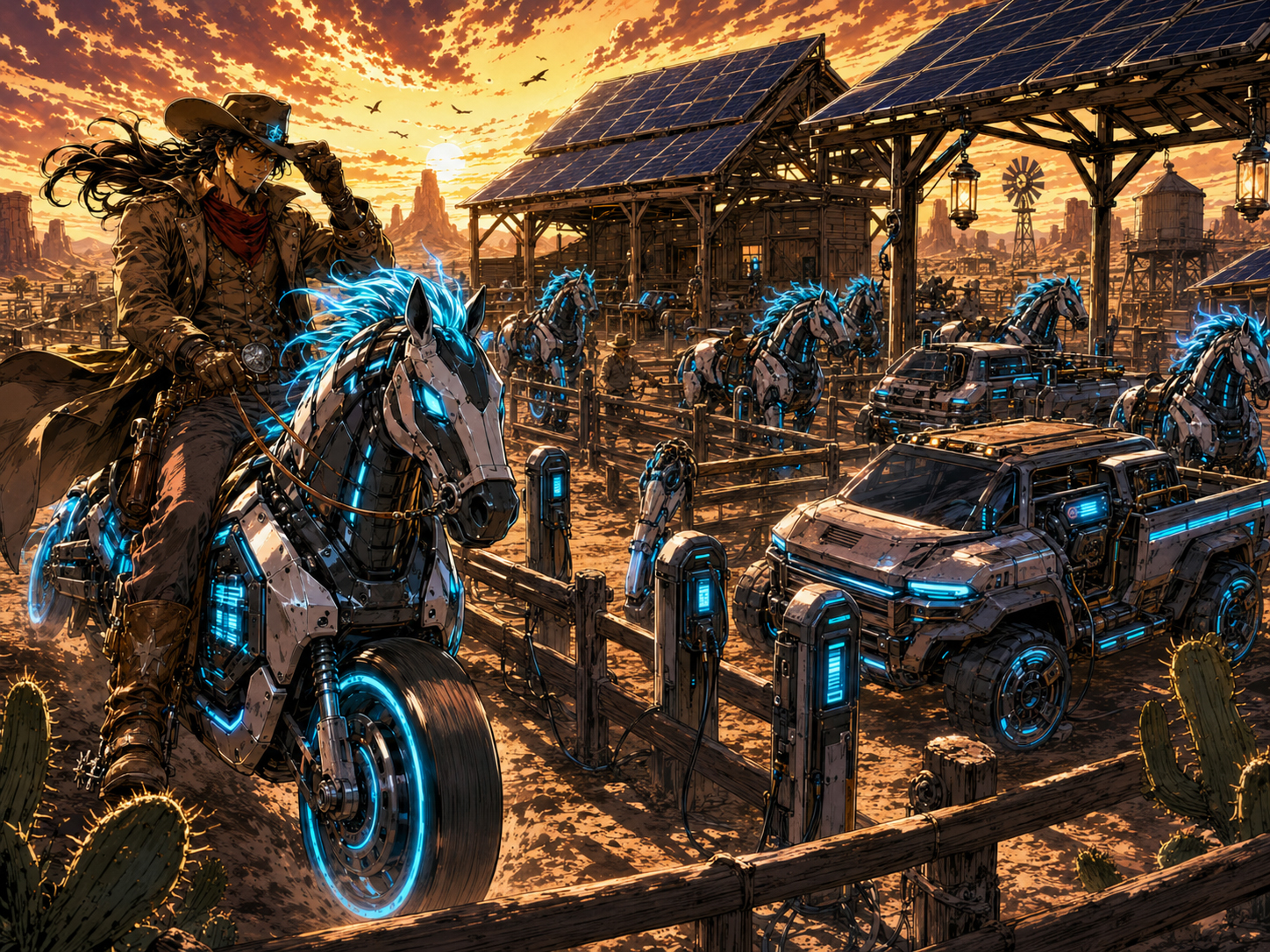
Solar panels make power when sunlight is available. A battery can store some of that energy for later use. That is especially useful when the EV comes home after sunset or when the ranch needs selected backup loads during an outage.
The design question is not just, “Can I add a battery?” The better question is: “What do I want the battery to do?” Backup, rate shifting, solar self-consumption, EV support, and resilience can lead to different system designs.
When the grid goes down, not every electrical load should keep dancing. A good backup plan chooses priorities.
Refrigeration, lighting, internet, communications, selected outlets, garage door, medical needs, and essential circuits are often better backup priorities than large luxury loads.
Air conditioning, electric heat, pool equipment, ovens, hot tubs, and other large loads may require larger systems, load controls, or careful exclusion from backup circuits.
EV charging can be a very large load. Charging an EV from home batteries during an outage may be possible in some systems, but it must be deliberately designed and sized.
Sometimes maybe. Often not first. The answer depends on battery size, inverter capacity, solar production, charger setting, critical-load priorities, and how long the outage may last.
| Outage Question | Why It Matters | EV Cowboy Guidance |
|---|---|---|
| How much battery energy is available? | Stored kWh determines how long loads can run. | Protect essential loads before spending backup energy on vehicle charging. |
| How much power can the inverter deliver? | Large chargers may exceed backup system output limits. | Use load calculations and manufacturer limits, not guesswork. |
| Is solar producing during the outage? | Daytime solar can help recharge batteries if the system is designed to operate during outages. | Solar-plus-battery design must be planned for outage operation. |
| Can the charger be limited? | Some chargers or systems can reduce charging current. | Managed or reduced charging may make more sense than full-power charging. |
| What are the critical needs? | Medical equipment, refrigeration, communication, and lighting may be more important than vehicle charging. | Prioritize the house before the horse. |
The Utility Baron loves late-afternoon and evening confusion. If electricity costs more during peak hours, charging or running heavy loads at the wrong time can become expensive.
Batteries may help shift solar energy or stored grid energy into higher-cost periods, depending on the system, utility rate, interconnection rules, and owner’s usage pattern. The goal is not magic. The goal is control.

Before buying equipment, the ranch needs clear goals. A battery system designed for one job may not be ideal for another.
Focus on selected critical loads, outage duration, inverter capacity, battery size, solar recharge, and safe transfer equipment.
Focus on when the home uses power, when the EV charges, when solar is produced, and which utility rate periods are expensive.
Focus on capturing excess solar production and using it later instead of exporting low-value energy where that applies.
Focus on whether the EV must charge during outages, at what rate, for how long, and what other loads must stay powered.
Whole-home backup can require larger inverter capacity, more batteries, load controls, generator integration, or staged operation.
The most practical system may be the one that backs up the right loads, not every load. Smart design beats overpromising.
The town panics when the lights flicker. Madame Gasoline spills a drink. The Utility Baron smiles from the balcony. Then Battery Belle opens the doors to her solar saloon, glowing warm and calm.
“I stored the sunshine,” she says, while Sheriff Kilowatt points to the battery bank and explains that the saloon is not running on miracles. It is running on a design.
Most battery disappointments start with a mismatch between expectations and system design. Battery Belle avoids that by asking boring questions before the dramatic sunset scene.
Batteries have output limits and storage limits. A design must define what is backed up and what is not.
Large loads can drain batteries quickly or exceed inverter limits. Load management may be needed.
A high-power EV charger can be too large for a modest backup battery system unless specifically planned.
Solar can help recharge batteries during the day, but only when the system is designed to operate properly in outage conditions.
Short outage support and full off-grid operation are different design problems with very different equipment needs.
Batteries, inverters, transfer equipment, and EV charging systems must meet applicable code, listing, spacing, and installation requirements.
EV Cowboy is a manga comedy and educational site. It is not an electrical design, battery design, engineering document, permit set, installation instruction, or substitute for licensed professionals.
Battery systems, solar arrays, EV chargers, transfer equipment, load panels, service upgrades, breakers, wiring, conduit, and backup-power systems must be designed, permitted, installed, inspected, and operated according to applicable electrical codes, fire codes, manufacturer instructions, utility requirements, and local authority rules.
Once the ranch has solar and batteries, the next lesson is the sunset ambush: peak rates, charging schedules, and why timing can be as important as equipment.