No Wiring Advice
The site does not tell you how to wire chargers, batteries, inverters, panels, circuits, transfer equipment, or solar systems.
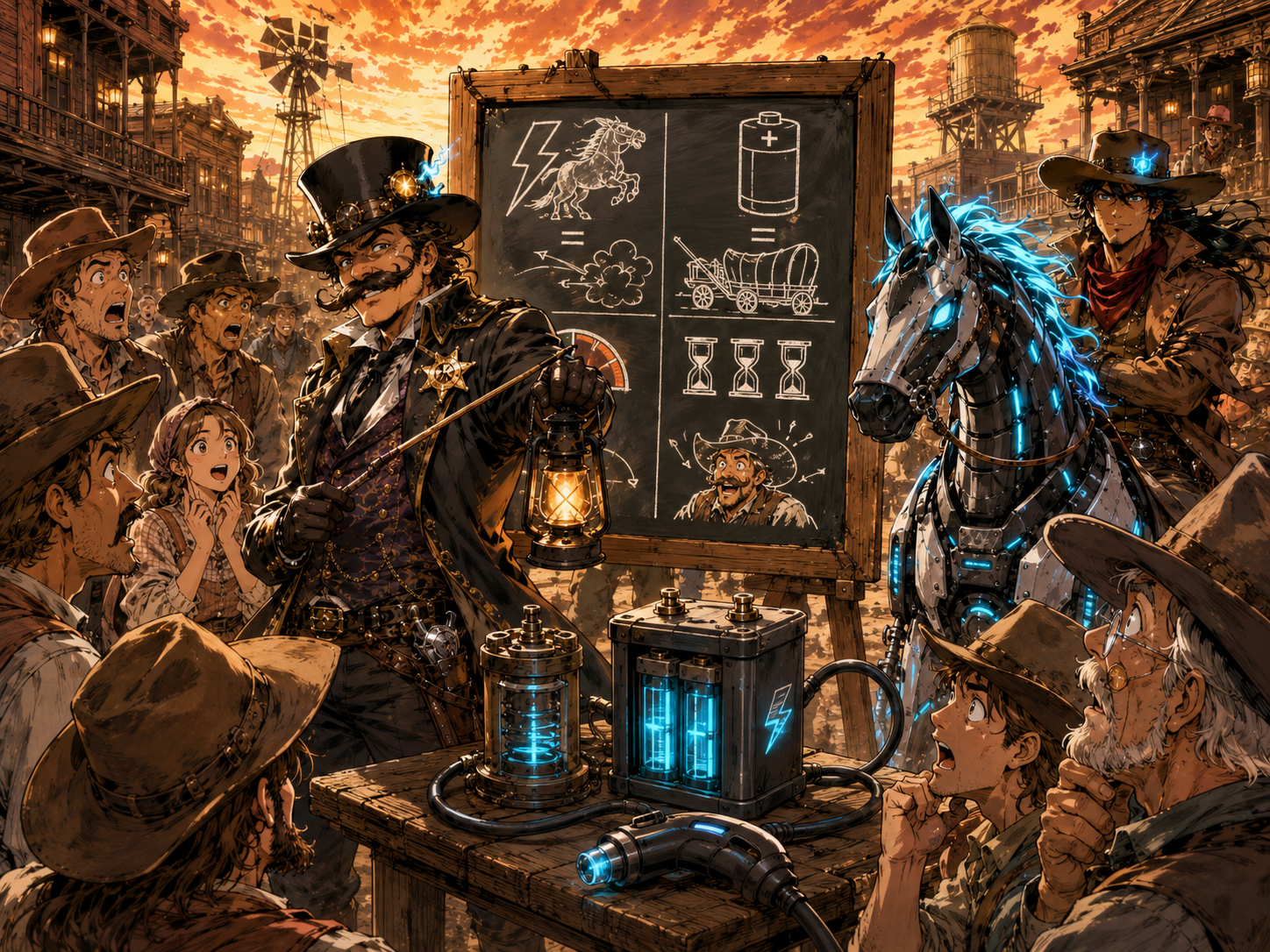
EV Cowboy is educational comedy. The hats are funny. The electricity, chargers, solar, batteries, rates, and vehicles are real.
EV Cowboy is a manga comedy and educational website. It uses fictional characters, exaggerated western scenes, and humor to introduce general concepts about electric vehicles, EV charging, solar power, battery storage, backup power, peak rates, kW, kWh, and energy planning.
The information on this site is general, simplified, and story-based. It is not electrical advice, engineering advice, construction advice, vehicle advice, route advice, financial advice, utility-rate advice, legal advice, tax advice, fire-code guidance, permit instruction, or installation instruction.
Real projects require site-specific review by qualified professionals. Real equipment must be installed, inspected, operated, and maintained according to applicable rules, codes, manufacturer instructions, utility requirements, and local authority requirements.
EV Cowboy pages are not plans, drawings, specifications, calculations, permit sets, operating instructions, or code interpretations.
The site does not tell you how to wire chargers, batteries, inverters, panels, circuits, transfer equipment, or solar systems.
Structural, electrical, civil, fire-safety, utility, and equipment-design decisions require qualified professional review.
Vehicle range, charging speed, towing ability, payload, power output, and performance must be verified with manufacturers and real conditions.
The following systems can involve shock, fire, backfeed, utility, structural, permitting, and operational risks.
| System | Why It Matters | Proper Trail |
|---|---|---|
| EV chargers | They can be large continuous electrical loads. | Use qualified design, proper circuits, permits, inspections, and listed equipment. |
| Solar arrays | They involve roof attachment, DC wiring, inverters, disconnects, and utility rules. | Follow code, manufacturer instructions, structural requirements, and interconnection rules. |
| Battery systems | They store significant energy and may have fire-code, spacing, and control requirements. | Use listed systems, approved installation methods, proper clearances, and professional commissioning. |
| Backup power | Improper transfer can create dangerous backfeed or overloads. | Use approved transfer equipment, critical-load planning, and code-compliant installation. |
| Service upgrades | Adding EV charging or batteries can affect service capacity and utility equipment. | Coordinate with qualified professionals, utilities, and local authorities. |
| Fleet charging | Multiple vehicles can create major load and scheduling issues. | Plan capacity, managed charging, utility coordination, and actual duty cycles. |
Electrical codes, fire codes, building codes, zoning rules, utility requirements, manufacturer instructions, product listings, and local authority interpretations can vary by location and project.
EV Cowboy does not determine what is legal, safe, permitted, interconnectable, insurable, or code-compliant for your site. The authority having jurisdiction, utility, manufacturers, qualified designers, licensed contractors, and inspectors control real project requirements.

EV Cowboy includes jokes and examples about road trips, desert rides, racing, towing, electric trucks, and silent steeds. These are educational storytelling devices, not travel instructions or performance guarantees.
Vehicle range, charging speed, connector compatibility, towing range, payload, road-trip time, public charger availability, weather impact, terrain impact, and vehicle performance vary by vehicle, conditions, equipment, software, driver behavior, and route.
EV Cowboy discusses peak rates, bills, solar value, batteries, and energy timing in a simplified educational style.
Electricity rates, time-of-use periods, demand charges, export compensation, fixed charges, utility programs, and interconnection rules can change and vary by location, utility, customer class, and tariff.
Savings depend on actual usage, rate schedule, system size, equipment, solar production, battery operation, EV charging behavior, financing, incentives, maintenance, and utility rules.
Incentives, tax credits, grants, rebates, domestic-content rules, and eligibility requirements should be reviewed with qualified tax, legal, finance, and program professionals.
EV Cowboy is not financial advice, investment advice, tax advice, utility-rate advice, or a promise of payback, savings, eligibility, or approval.
EV Cowboy may discuss general categories such as EV chargers, solar panels, inverters, batteries, electric trucks, solar canopies, backup systems, or load-management equipment.
Mentioning a category, technology, feature, or example does not mean it is suitable for every site, approved for every jurisdiction, compatible with every system, available in every market, or recommended for every customer.
EV Cowboy may link to ABCSolar.com, utilities, manufacturers, agencies, articles, standards bodies, maps, charger networks, or other third-party websites.
External sites are controlled by their own owners and may change without notice. EV Cowboy and ABC Solar are not responsible for third-party content, pricing, availability, claims, policies, security, accuracy, or practices unless expressly stated in writing. Links do not necessarily mean endorsement, partnership, sponsorship, approval, or responsibility.
EV charging technology, vehicles, solar equipment, battery systems, utility rates, incentive rules, building codes, fire codes, electrical codes, and local requirements can change.
EV Cowboy aims to provide useful general education, but information may become incomplete, outdated, simplified, or unsuitable for a specific site or situation. Always verify current requirements, product instructions, utility programs, code rules, permits, and professional guidance before making decisions.
Last updated:

By using EV Cowboy, you understand that the site is provided for general education and entertainment. You are responsible for your own decisions and for obtaining qualified advice before taking action.
To the fullest extent permitted by law, EV Cowboy, ABC Solar Incorporated, and related parties disclaim liability for losses, damages, injuries, claims, costs, delays, failed inspections, equipment issues, lost savings, utility changes, route problems, or other consequences related to reliance on general site content.
Real EV charging, solar, battery, and backup projects should be reviewed by qualified, licensed, insured, and appropriately experienced professionals.
Contact qualified electrical and solar professionals who can review the site, loads, service, equipment, codes, permits, utility requirements, and installation details.
Contact qualified tax advisors, attorneys, insurance professionals, lenders, incentive administrators, and utility representatives as appropriate.
EV Cowboy is brought to you by ABC Solar Incorporated.
ABC Solar Incorporated
24454 Hawthorne Blvd
Torrance, CA 90505
Phone: 1-310-373-3169
Email: [email protected]
Website: ABCSolar.com
California Contractor License: CCL #914346