Panel 1: High-Noon Shadows
The sun is straight overhead. Dust hangs in the street. The charging post stands alone like it has challenged the whole town.
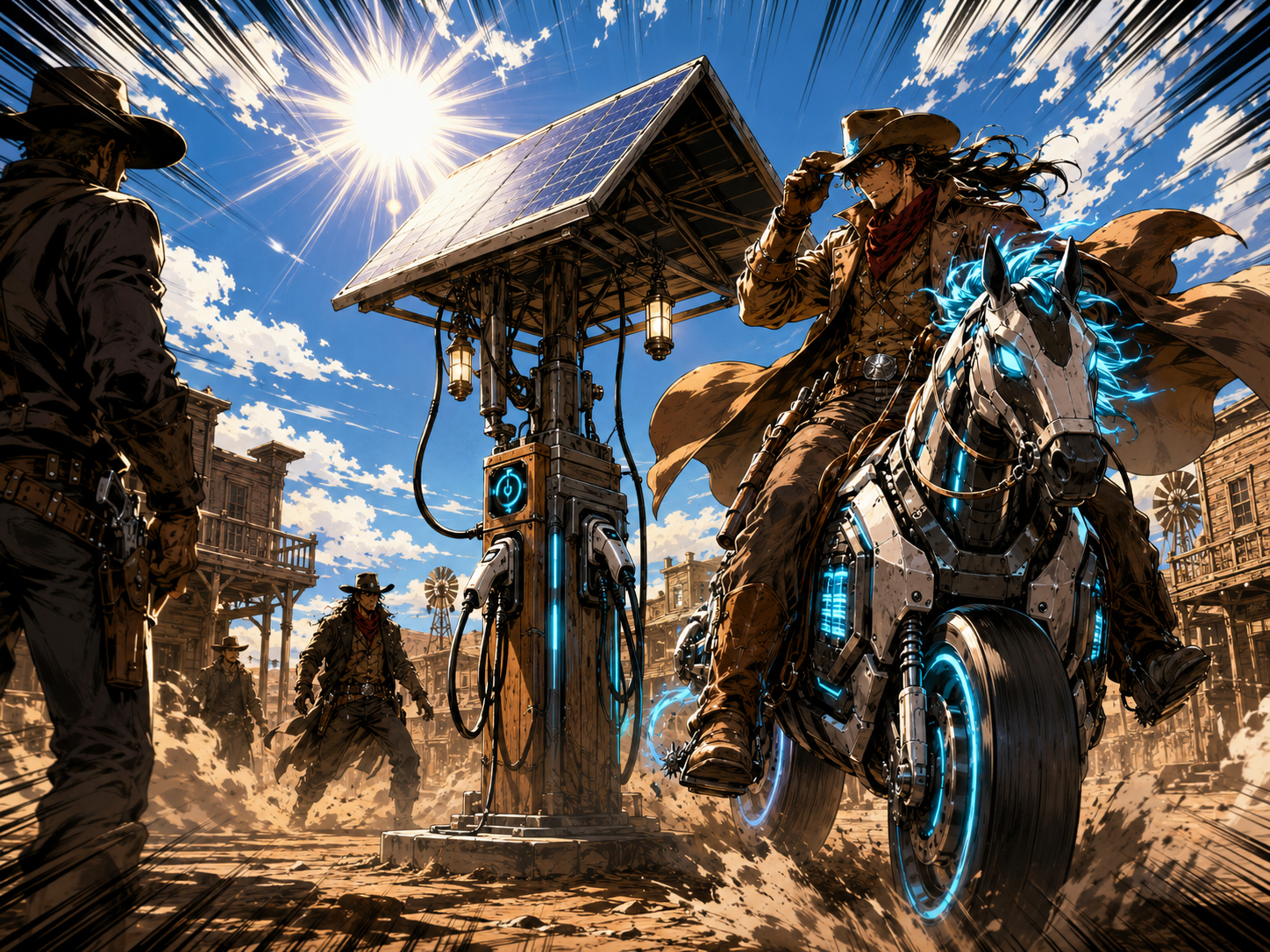
The town gathers around the new hitching post with wires. Everyone wants to plug in. Sheriff Kilowatt wants everyone to calm down first.
After the gasoline stagecoach’s smoky public embarrassment, the town finally admits the electric steed needs a proper place to charge. By noon, a new post stands in the middle of Main Street: part hitching rail, part charger, part frontier mystery.
The old cowboys circle it like it might bite. Madame Gasoline says it looks suspiciously quiet. The town mechanic asks whether it takes oil. The Utility Baron watches from the balcony, already wondering how to charge for the charge.
EV Cowboy rides Sparky to the post. The blue mane dims into a gentle glow. A charging cable clicks into place. The town gasps as if someone just saddled lightning.
This episode should look like a classic western standoff, except the weapons are cables, breakers, meters, and bad assumptions.
The sun is straight overhead. Dust hangs in the street. The charging post stands alone like it has challenged the whole town.
EV Cowboy connects Sparky to the charger. A clean blue glow moves through the cable. The crowd leans forward.
One cowboy dives behind a water trough. Another asks whether the electricity can smell fear.
Sheriff Kilowatt raises one hand and says, “Nobody touches the charger until we talk about circuits.”
From the balcony, the Baron whispers, “A new load. A new bill. A new opportunity.”
Sheriff Kilowatt drags out the chalkboard. The town groans. Sparky politely continues charging.
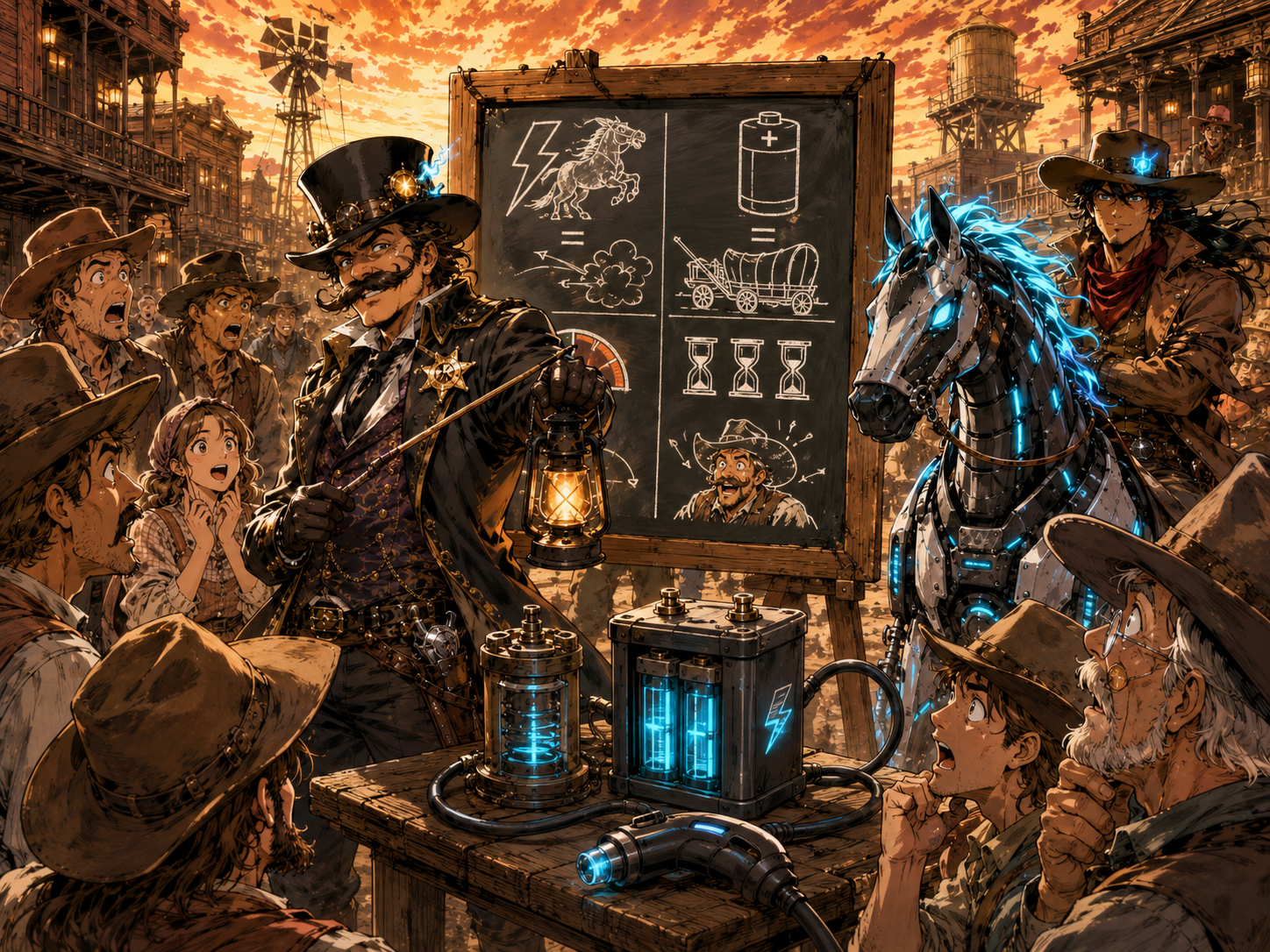
The town thinks the charging post is a simple device. Sheriff Kilowatt explains that the visible charger is only the front door. Behind it are breakers, wires, conduit, panel capacity, load calculations, utility rules, permits, and inspections.
A proper charger must match the electrical system, the vehicle’s needs, the installation location, and the daily charging routine. A charger that looks strong can still be wrong if the circuit behind it is not designed correctly.
Everyone sees the charging post differently, which is exactly why Sheriff Kilowatt needs a bigger chalkboard.
He knows the steed needs energy, but he also knows the charger must be safe, useful, and properly planned.
He treats the charging post like town infrastructure, not a toy for curious cowboys with metal spurs.
She says the charger lacks romance, then quietly asks whether the saloon could use one for “research.”
He does not fear the charger. He fears a charger powered by solar, batteries, and customers who understand rates.
Episode 3 is the practical turning point. The town learns that EV charging is not magic and not a decoration.
| Manga Moment | Town Misunderstanding | Real Energy Lesson |
|---|---|---|
| The charger glows blue. | The town thinks glow means unlimited power. | Charger output is limited by circuit, equipment, vehicle, and installation design. |
| Everyone wants to plug in. | They assume all loads can run at once. | Multiple chargers or large loads may require load management and service review. |
| The post stands outdoors. | They think all equipment survives weather automatically. | Outdoor chargers need appropriate ratings, installation, protection, and code compliance. |
| The cable reaches the steed. | They think cable length is the main design issue. | Wire size, breaker rating, conduit, voltage drop, and equipment instructions matter. |
| The Utility Baron watches. | They forget the bill. | Charging time and rate schedule can affect operating cost. |
The dialogue should play like a western showdown where every dramatic line gets interrupted by practical electrical reality.
Old Cowboy: “So we just plug the horse in?”
Sheriff Kilowatt: “Steed. And no.”
Madame Gasoline: “Looks like a hitching post with a headache.”
EV Cowboy: “It is a charger.”
Old Cowboy: “Can I plug my coffee pot into it?”
Sheriff Kilowatt: “That question is why I brought the chalkboard.”
Utility Baron: “Charge now. Ask questions after sunset.”
Battery Belle: “That man invoices like a rattlesnake.”
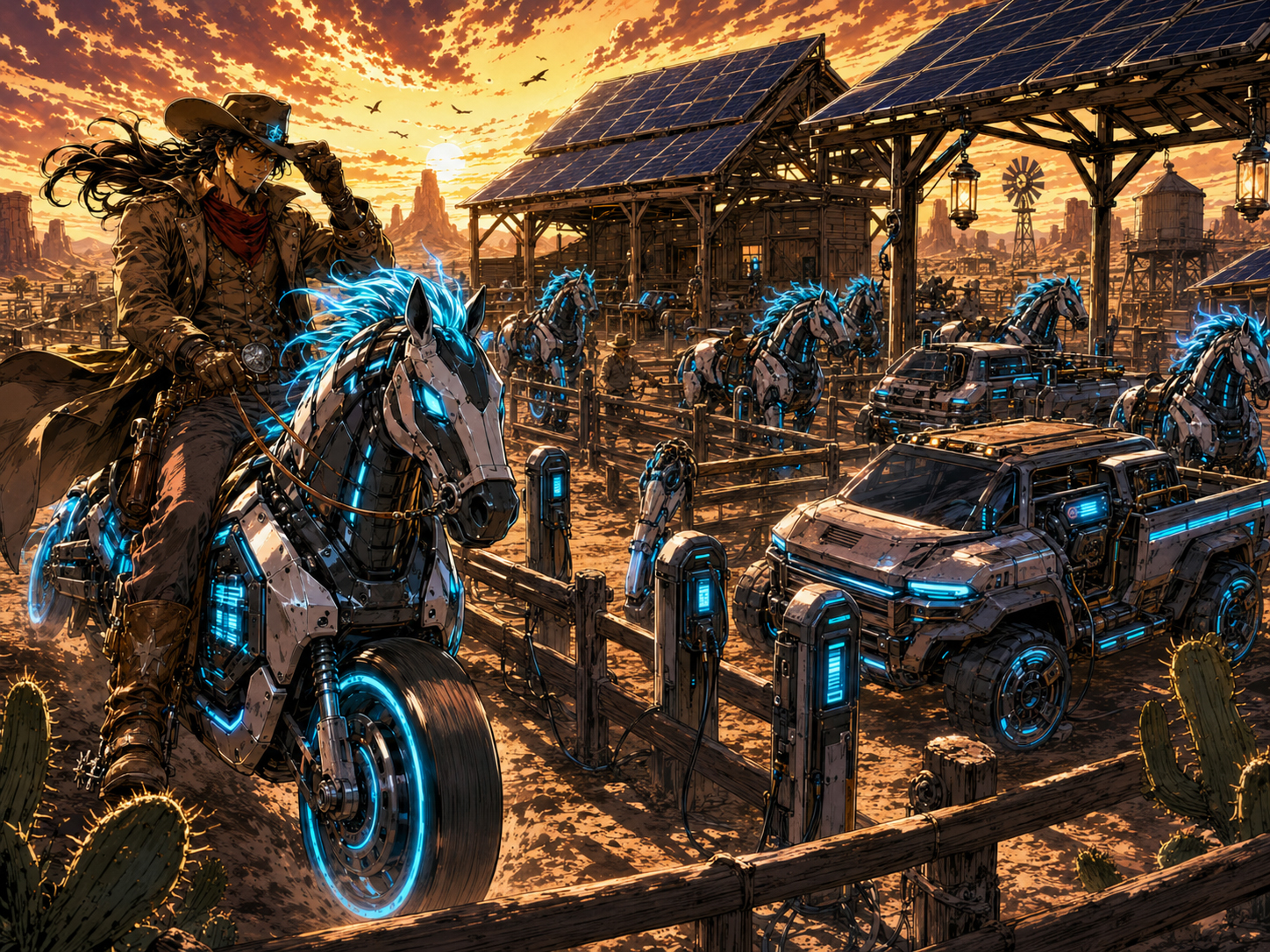
The town celebrates the first charging post too soon. One charger can feed one steed, but a growing town needs a bigger plan. What happens when electric trucks arrive? What happens when Battery Belle wants a charger at the saloon? What happens when every cowboy comes home at sunset?
EV Cowboy looks at the empty lots, the rooftops, and the strong western sun. He sees the next answer: not just a charging post, but a solar charging corral.
Treat the charging post like the star of a western duel. It should be simple enough to understand and dramatic enough to remember.
Use hard sunlight, long dust lines, tense silhouettes, and classic standoff framing around the charger.
Let the charger and Sparky glow clean electric blue against warm western browns, golds, and oranges.
The crowd should react as if the cable is alive: surprise, fear, curiosity, bad advice, and overconfident pointing.
Include a meter, breaker box, conduit, solar panel sketch, charging cable, and Sheriff Kilowatt’s chalkboard.
The key lesson is that EV charging works best when it is designed around the site and the user. Daily miles, parking location, charger power, circuit size, service capacity, utility rate, solar potential, and backup goals all matter.
A charger installed without planning can create cost, inconvenience, failed inspections, or unsafe conditions. A charger planned well can make the electric steed feel natural, reliable, and easy to live with.
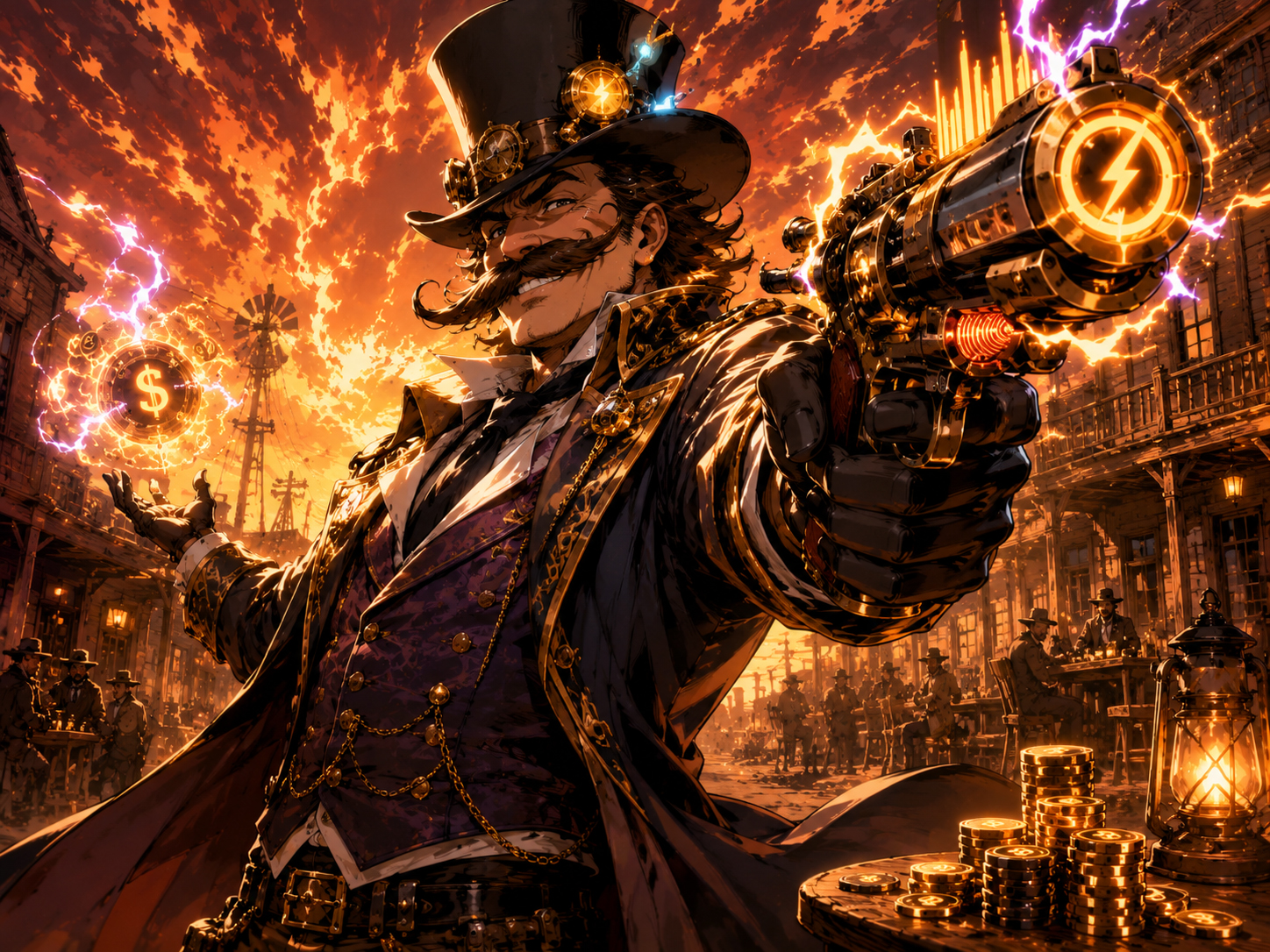
At the end of the episode, the town cheers because Sparky is charging. Sheriff Kilowatt allows himself one small nod. Then the sun begins to drop.
The Utility Baron steps out of the balcony shadows and unfurls a rate schedule longer than a cattle drive. The charger works. The next question is what it costs, and when.
EV Cowboy is educational comedy. EV charging equipment, panels, circuits, breakers, wire, conduit, solar systems, batteries, and backup-power equipment are real electrical systems requiring proper design and installation.
This episode is not electrical advice, engineering guidance, permit instruction, utility-rate advice, vehicle advice, or installation instruction. EV charging equipment and related systems must be designed, installed, permitted, inspected, operated, and maintained according to applicable electrical codes, fire codes, manufacturer instructions, utility requirements, rate schedules, and local authority rules.
The charging post works. The steed is calm. The town is proud. Then sunset arrives, and the Baron pulls out the bill.