Panel 1: The Town Celebrates
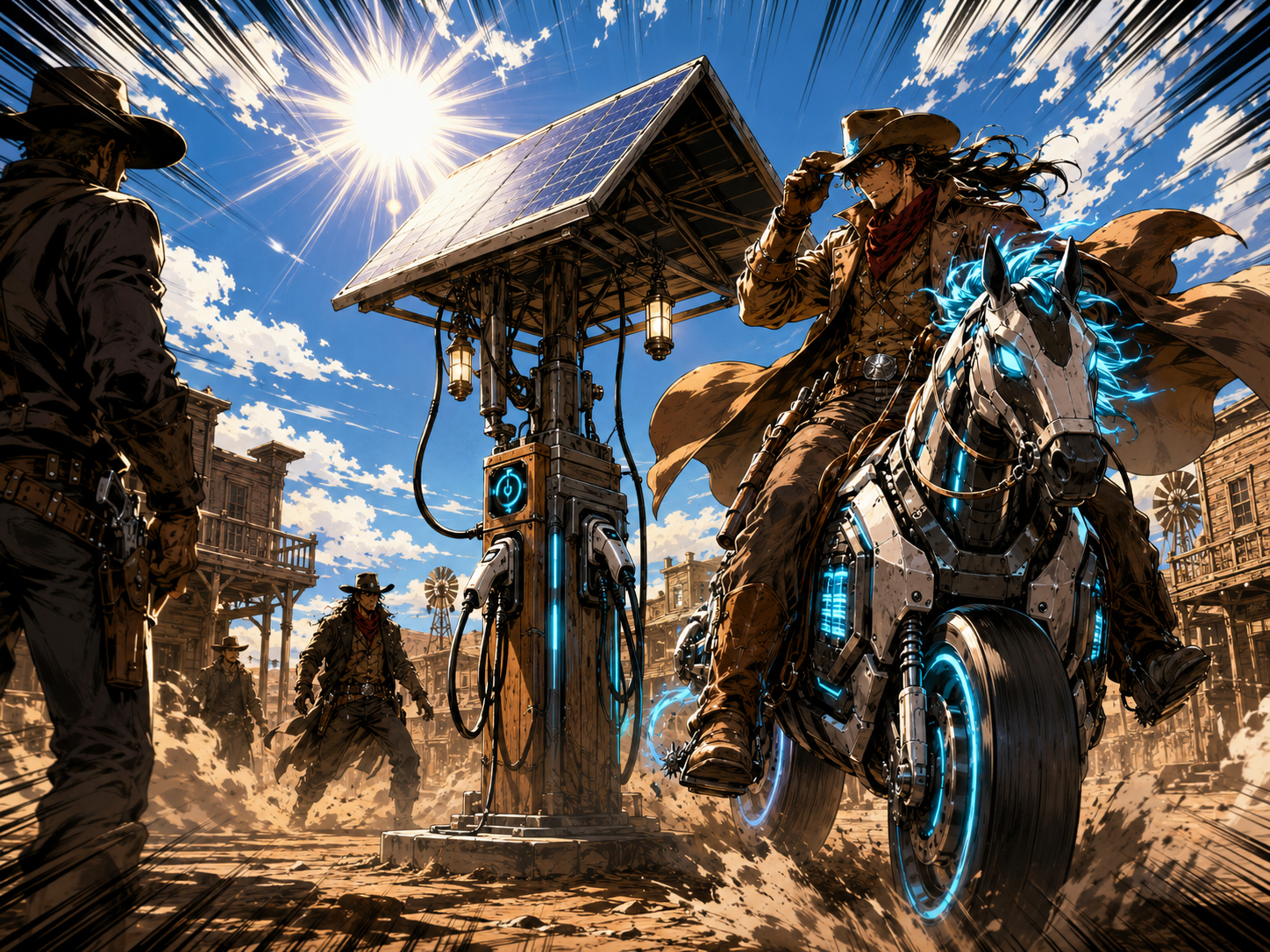
EV Cowboy leans against Sparky while the charging post hums. The townsfolk clap, relieved that nothing exploded.

The charging post works. The town cheers. Then sunset arrives, and the Baron steps into the street with a rate schedule longer than a cattle drive.
All afternoon, the town admires the charging post. Sparky is plugged in. The blue glow is steady. Sheriff Kilowatt is almost proud. Even Madame Gasoline admits the charger is “annoyingly tidy.”
Then the sun drops behind the saloon roof. The street turns orange. The lanterns come on. Somewhere, a meter clicks with theatrical timing.
The Utility Baron steps out of the shadows wearing a dark coat, a gold watch chain, and a smile that has never paid retail. In one hand he holds a glowing peak-rate pistol. In the other, he holds the town’s new bill.
Episode 4 should feel like a classic western villain entrance, except the villain is armed with confusing rate windows.
EV Cowboy leans against Sparky while the charging post hums. The townsfolk clap, relieved that nothing exploded.
Long shadows stretch across Main Street. Sheriff Kilowatt notices the clock and suddenly stops smiling.
The Utility Baron steps from the balcony with a glowing pistol and a scroll of rate rules that unrolls down the stairs.
A bright blast hits the town meter. Numbers spin. The crowd screams at the bill instead of the bullet.
Battery Belle stands on the saloon porch and says, “I stored sunshine for this exact nonsense.”
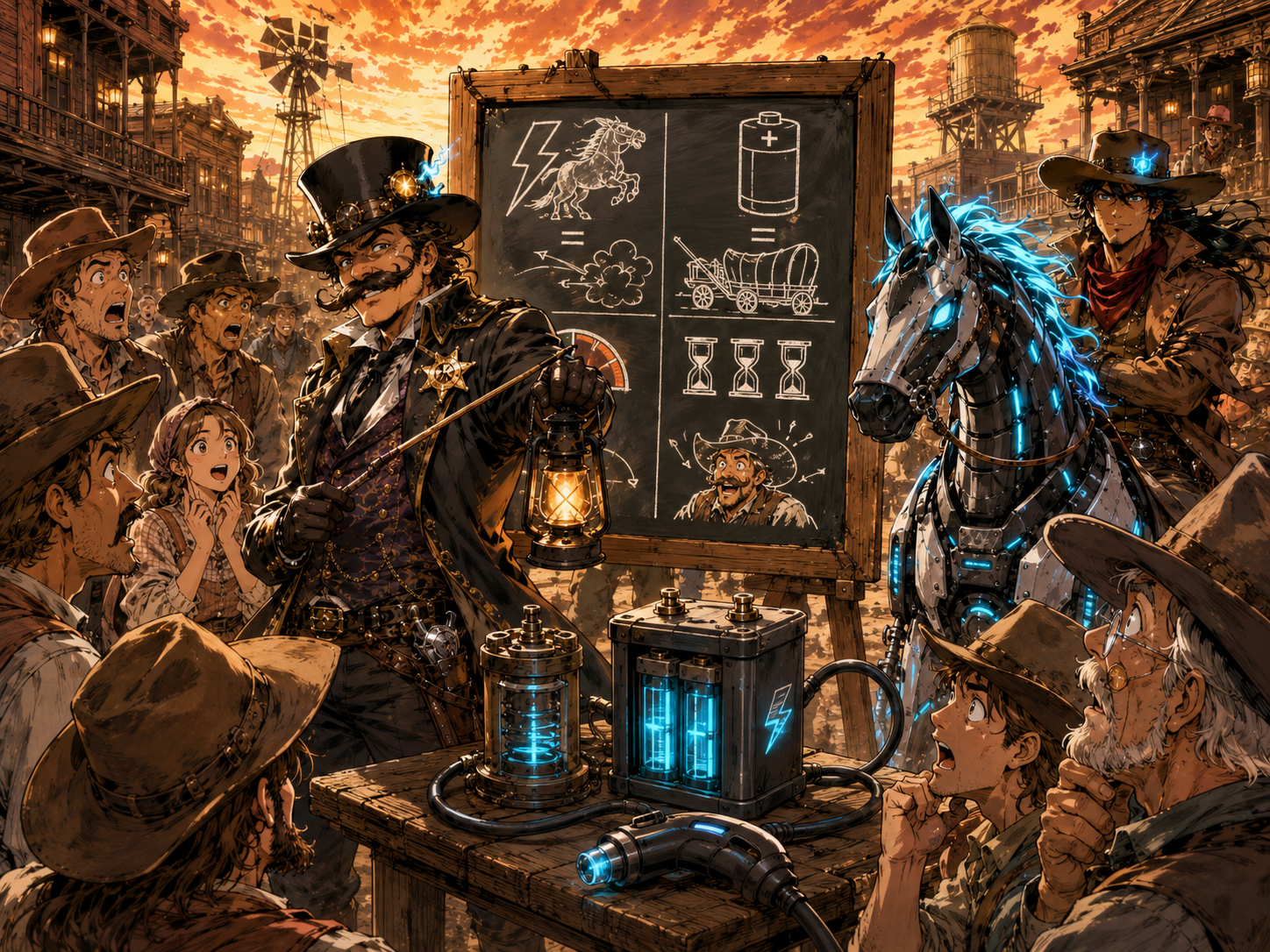
The Sheriff pulls out a chalk stick like a six-shooter and writes: “Plugged in does not mean charging now.”
The town thought the only question was whether the steed could charge. The Baron reveals the next question: when should the steed charge?
Many EVs and chargers can be scheduled. The vehicle can be plugged in for convenience but wait to draw power until a better time. That one idea changes the whole duel. The Baron wants panic charging at sunset. EV Cowboy wants a schedule.
The Utility Baron is dangerous because he understands timing before the town does.
He does not need to stop charging. He only needs the town to charge at the most expensive moment.
He plugs in, checks the schedule, and refuses to let the Baron turn urgency into a bill.
She has been saving solar energy all day and does not plan to buy panic power at sunset.
He explains that kWh, charger power, battery storage, and rate timing all need to be understood together.
The town learns that an EV charging system is not only equipment. It is also behavior, timing, and utility rules.
| Manga Moment | Town Misunderstanding | Real Energy Lesson |
|---|---|---|
| The steed is plugged in at sunset. | Everyone assumes charging must start immediately. | Plug-in time and charge-start time can be different. |
| The Baron fires the peak-rate pistol. | The town thinks the charger caused the bill. | Rate timing can affect charging cost. |
| Battery Belle stays calm. | People think she is lucky. | Batteries can help store energy for later use when properly designed. |
| Sheriff Kilowatt points at the clock. | The crowd stares at the cable. | Charging schedules and rate windows matter. |
| EV Cowboy delays charging. | The Baron says he is afraid. | Smart charging can be a cost-control strategy, not a weakness. |
This episode should feel like a standoff where the hero wins by understanding the schedule instead of drawing faster.
Utility Baron: “Charge now, cowboy. The sun is down and my rates are up.”
EV Cowboy: “Sparky can wait.”
Old Cowboy: “A horse can wait to eat?”
Sheriff Kilowatt: “It is not a horse.”
Battery Belle: “And I stored enough sunshine to keep the saloon bright.”
Utility Baron: “You read the schedule?”
EV Cowboy: “I read the trail before I ride.”
Sheriff Kilowatt: “Class begins again.”
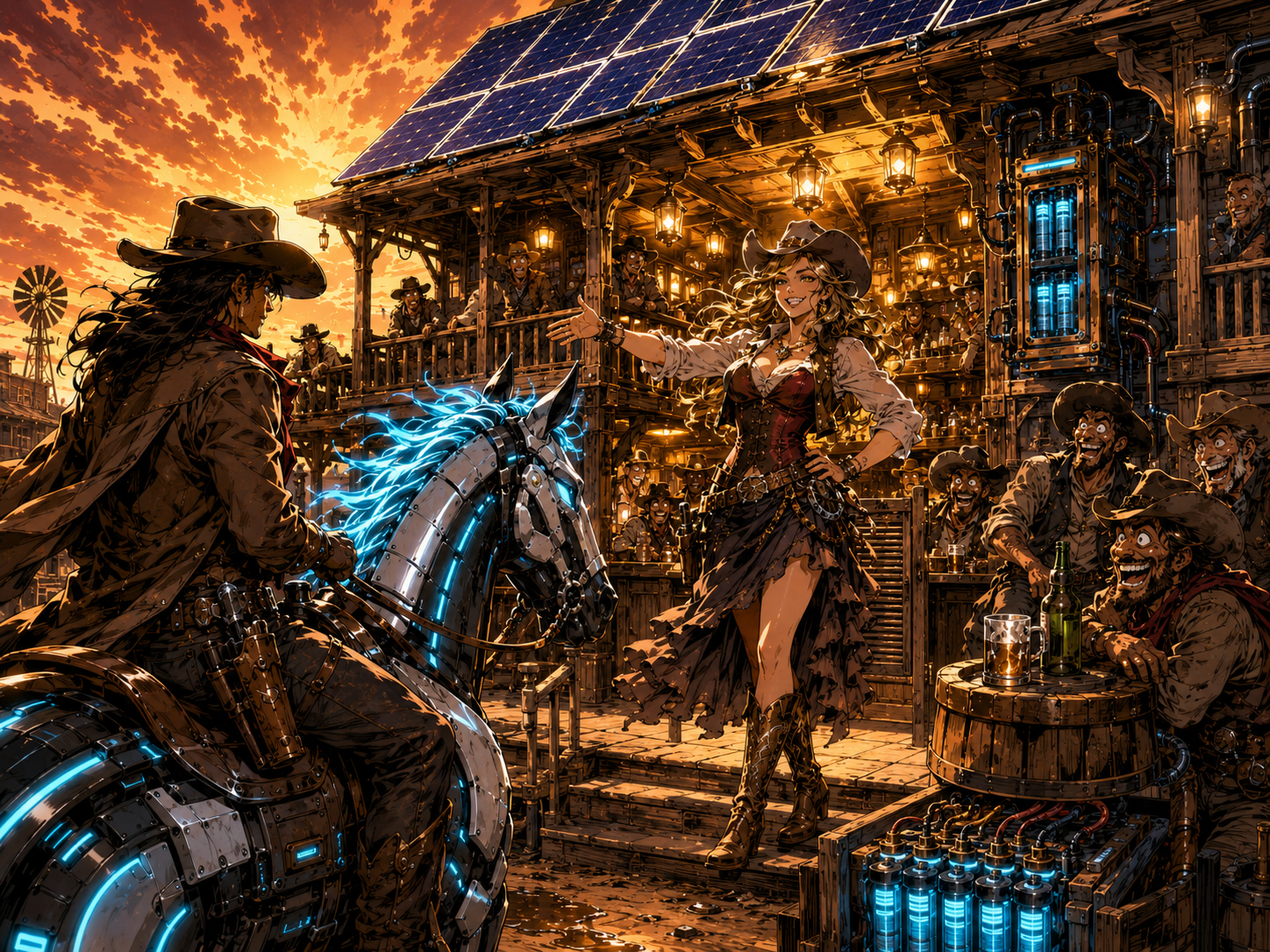
Battery Belle becomes the emotional hero of Episode 4 because she prepared before the crisis. While the town argued about the charging post, she watched the sun, the meter, and the clock.
In the real world, a battery can help shift energy, support selected backup loads, and improve control over when stored energy is used. But batteries must be sized, installed, and operated carefully. They are powerful tools, not infinite barrels.
Make this episode theatrical. It is a rate-schedule lesson wearing a villain cape.
Use long sunset shadows, gold highlights, purple clouds, and glowing meter effects around the Utility Baron.
The weapon should look ridiculous but memorable: part revolver, part meter, part energy graph, part monopoly threat.
Her saloon should glow warmly and confidently, with solar panels, battery details, and no panic.
End with Sheriff Kilowatt explaining that time is now part of the charging system.
The key lesson is that EV charging cost can depend on electricity rates, charging time, total kWh used, charger power, solar production, battery storage, and daily driving needs.
A good system does not just install a charger and hope. It considers the user’s schedule, the vehicle’s needs, the utility rate, the solar system, the battery system, and the household or business load pattern.
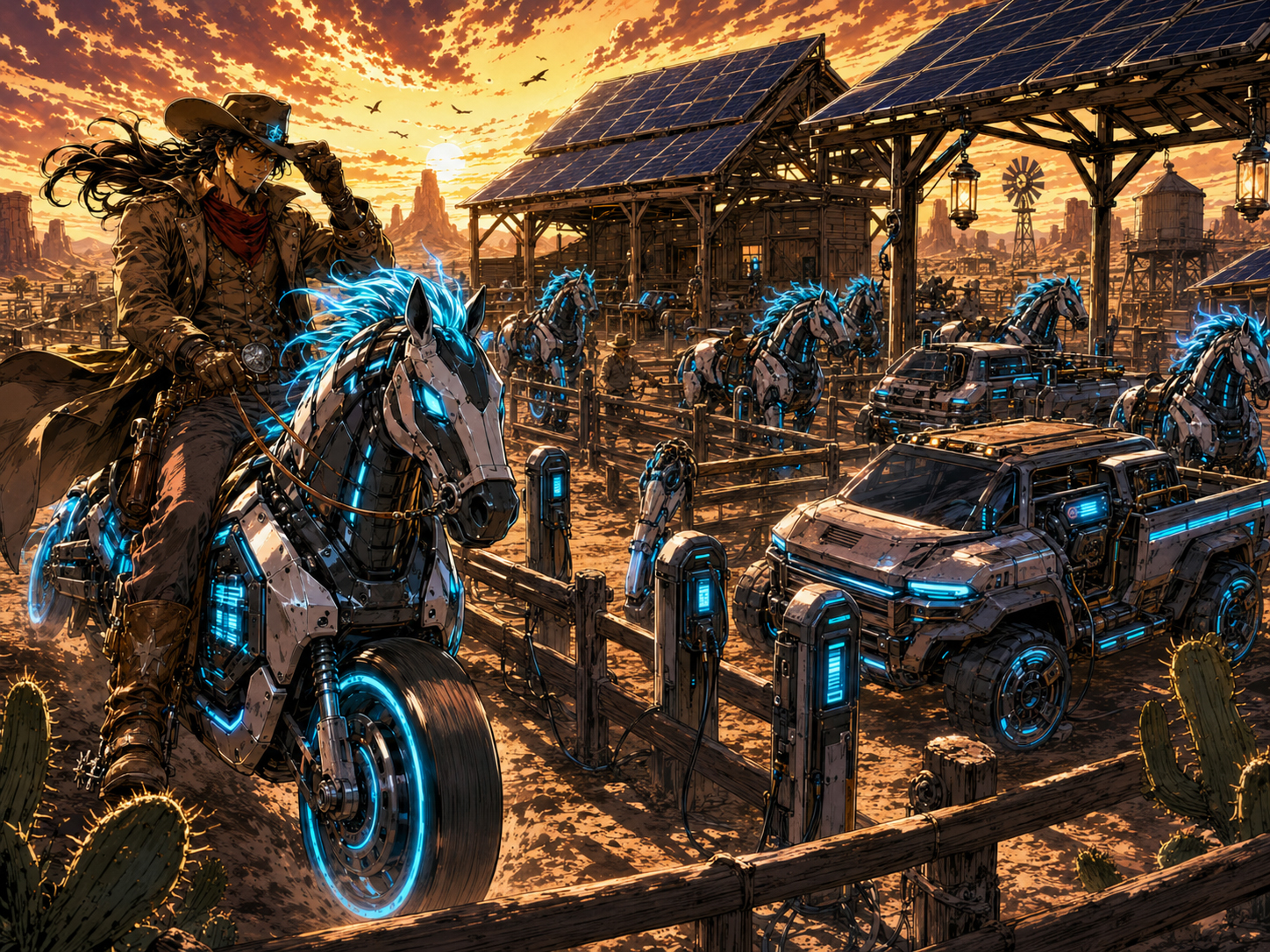
By the end of Episode 4, the town understands the villain: not electricity itself, but confusion about timing, rates, and control.
Solar Sensei walks into the street, looks at the rooftops, looks at the empty corral, and says the words that move the season forward: “Stop arguing at the charger. Build the sun corral.”
EV Cowboy is educational comedy. Utility rates, EV charging, solar systems, batteries, backup systems, and electrical installations require real review and professional judgment.
This episode is not electrical advice, engineering guidance, utility-rate advice, financial advice, vehicle advice, or installation instruction. EV chargers, solar arrays, batteries, inverters, service upgrades, load-management systems, backup-power equipment, breakers, wiring, conduit, and connected systems must be designed, installed, permitted, inspected, operated, and maintained according to applicable codes, manufacturer instructions, utility requirements, rate schedules, and local authority rules.
The Baron has revealed the ambush. Now Solar Sensei turns the whole town toward solar canopies, battery storage, charging posts, and a plan bigger than one plug.