Panel 1: Madame Gasoline’s Grand Entrance
Madame Gasoline stands proudly beside the gasoline stagecoach while two assistants polish the same dent from opposite sides.
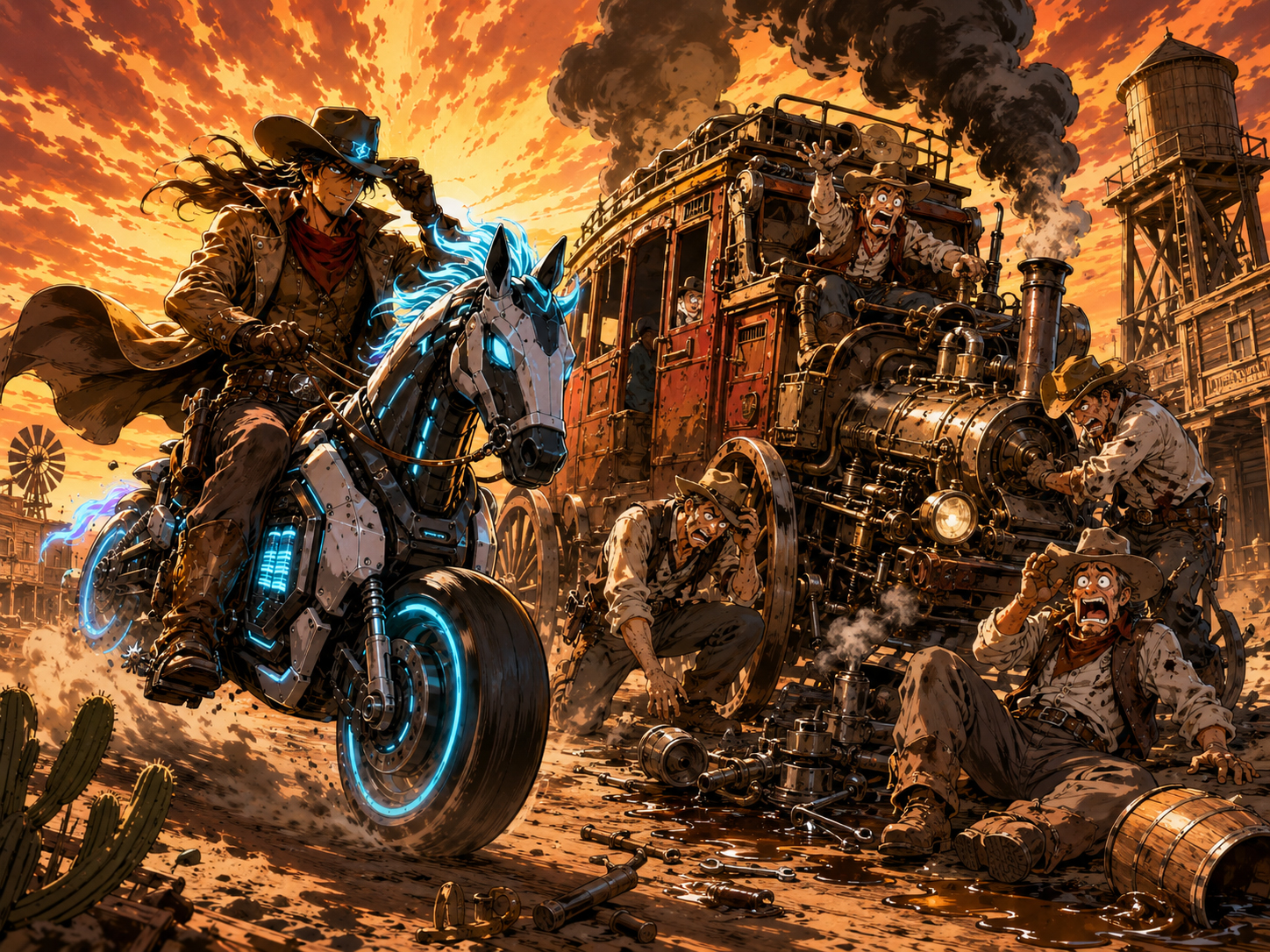
The old fuel machine coughs, smokes, leaks, and makes enough noise to convince the whole town that “traditional horsepower” may need a mechanic.
Main Street is still arguing about the electric steed when Madame Gasoline rolls out her pride and joy: the town’s famous gasoline stagecoach, polished in front, patched in back, and leaking from somewhere nobody wants to name.
“This,” she declares, “is proven transportation.” The engine coughs. A belt squeals. A small puff of smoke rises from the front like a bad omen wearing a hat.
The old cowboys cheer anyway. It is loud, therefore it must be powerful. It shakes, therefore it must be working hard. It smells terrible, therefore it must be serious.
The page should feel loud, chaotic, and ridiculous: big reactions, flying tools, smoke clouds, and one calm electric steed in the corner.
Madame Gasoline stands proudly beside the gasoline stagecoach while two assistants polish the same dent from opposite sides.
The stagecoach coughs, rattles, and spits smoke. The crowd applauds because nobody wants to admit that sounds expensive.
EV Cowboy sits on his silent steed, arms crossed, while Sparky’s blue mane glows politely.
A wheel wobbles. A pipe pops. A cowboy loses his hat in the smoke cloud.
The town mechanic crawls under the stagecoach and immediately asks for more money, more time, and fewer witnesses.
Sparky rolls forward without a sound. The stagecoach answers by dropping a spring into the dust.
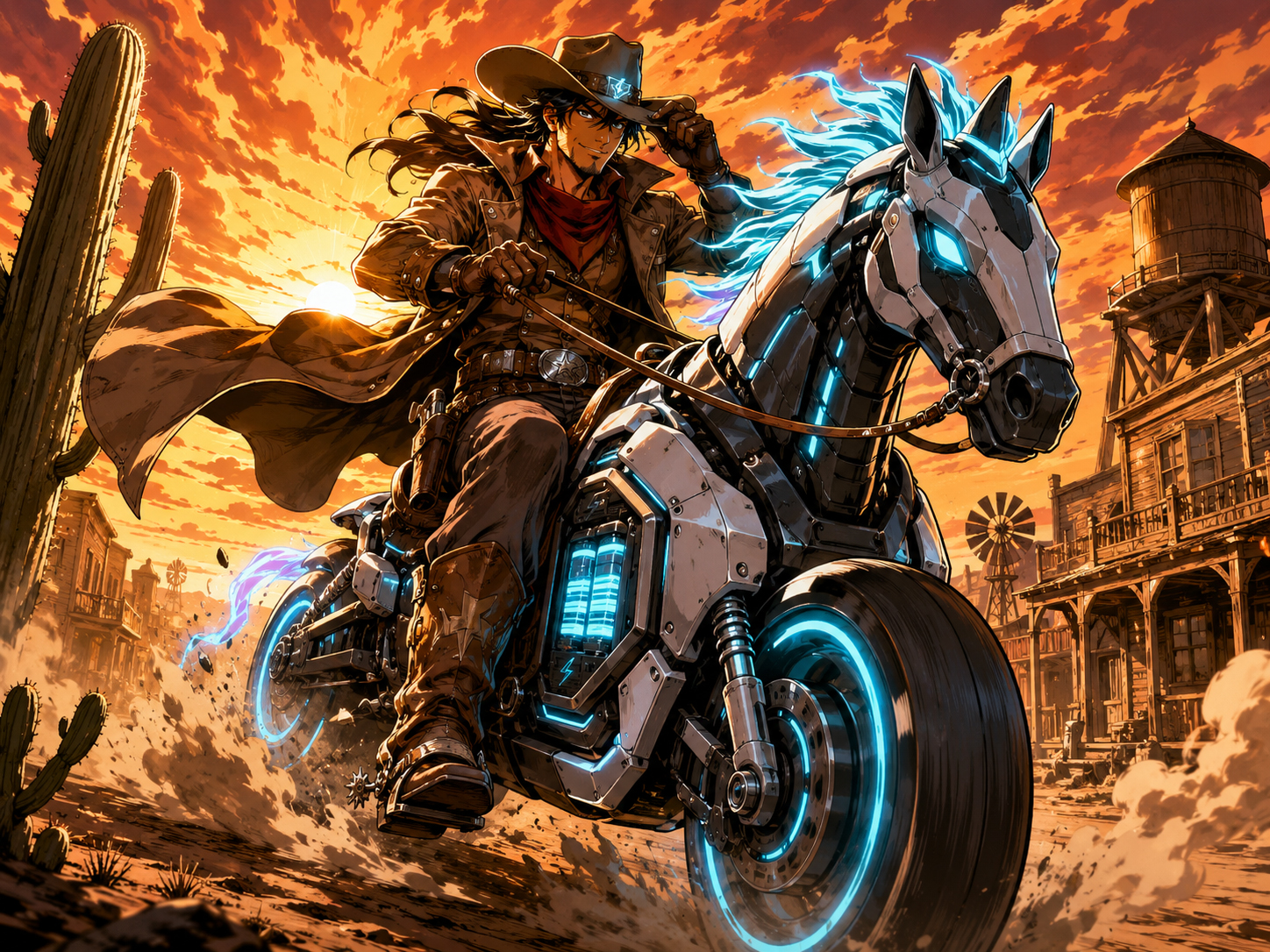
The old cowboys are used to noise. Noise feels like power. Smoke feels like effort. Vibration feels like work. They assume the electric steed is weak because it does not announce itself with a mechanical tantrum.
Then EV Cowboy asks Sparky to move. The steed glides forward, smooth and quiet, leaving the stagecoach crew frozen in a cloud of their own confidence.
The fun of Episode 2 is that every character sees the breakdown through their own bias.
She calls the smoke “heritage vapor” and insists the stagecoach is only resting between heroic moments.
He does not mock the town. He lets the old machine demonstrate the lesson by itself.
He writes “noise ≠ useful work” on a chalkboard and waits for someone to stop coughing.
He notices that both old fuel and new charging can be profitable when people are confused.
The breakdown is funny, but the real lesson is bigger: transportation energy habits are changing.
| Manga Moment | Town Misunderstanding | Real Energy Lesson |
|---|---|---|
| The stagecoach is loud. | The town assumes noise proves power. | Useful motion is not the same as sound, vibration, or smoke. |
| The stagecoach breaks down. | Madame Gasoline calls it “routine character.” | Old fuel systems have maintenance, fuel dependence, and mechanical complexity. |
| Sparky moves quietly. | The town thinks quiet means weak. | Electric drive can feel smooth, responsive, and powerful without engine drama. |
| The old pump is empty. | Everyone panics because the fuel map failed. | EV charging can happen at homes, businesses, ranches, parking lots, and planned destinations. |
| EV Cowboy points at the rooftops. | The town thinks he is admiring shingles. | Solar can become part of the charging plan when properly designed. |
Keep the dialogue short and fast, like manga panels with big expressions and ridiculous confidence.
Madame Gasoline: “Behold! Proven transportation!”
Stagecoach: “KOFF-KOFF-BANG.”
Old Cowboy: “Hear that? Real horsepower.”
Sheriff Kilowatt: “That was a misfire.”
Mechanic: “That was three billable hours.”
EV Cowboy: “Sparky, step forward.”
Sparky: “…”
Town Crowd: “It moved without yelling!”
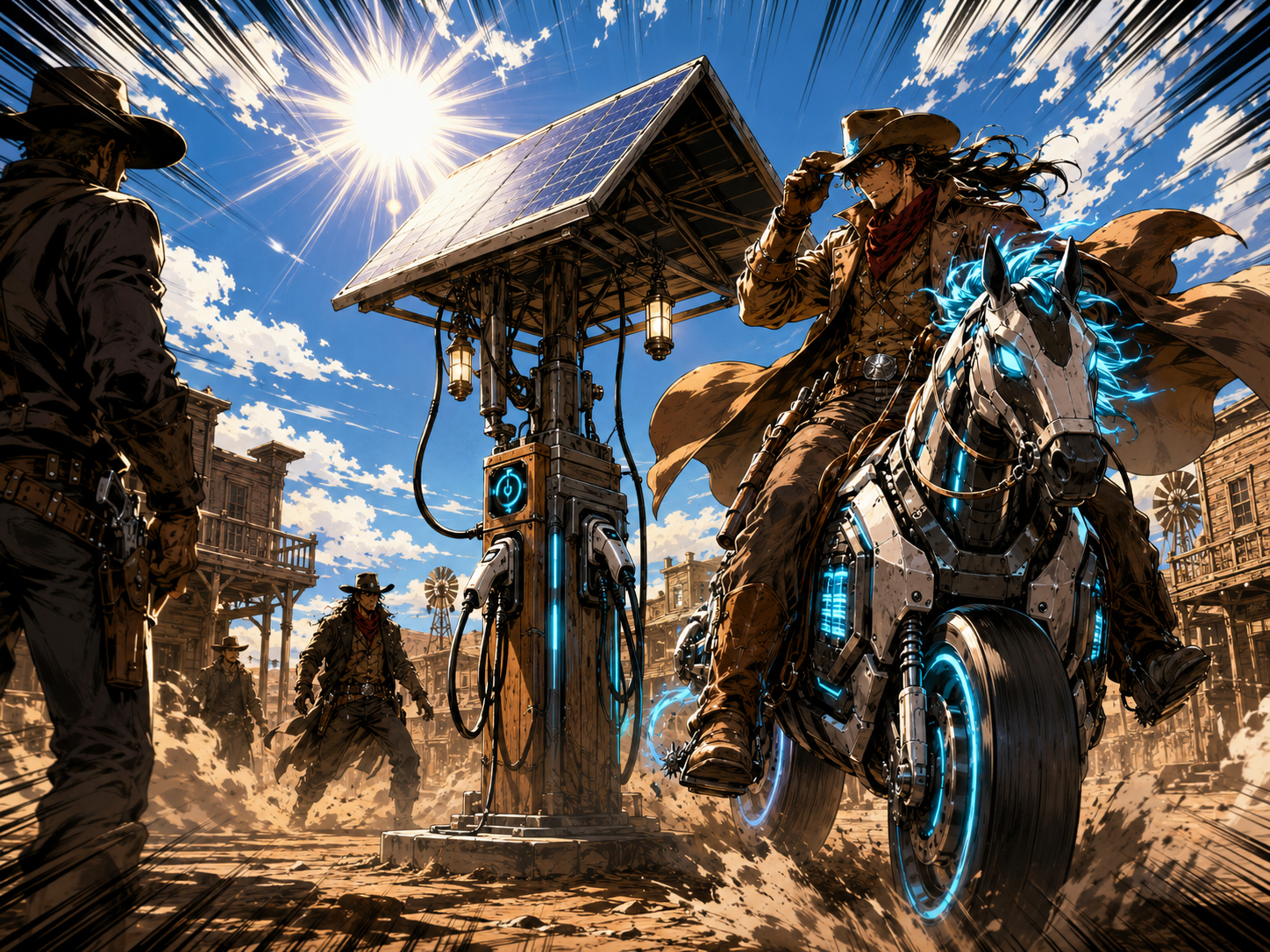
After the gasoline stagecoach fails, the town starts to understand the problem. The EV steed works, but the town has no proper place to feed it.
Someone points to a lamp post. Someone else points to a telegraph wire. The mechanic points to a barrel of unknown fluid and says, “Maybe electricity is inside this.” Sheriff Kilowatt closes his eyes and prays for a chalkboard.
This episode should be visually noisy on one side and calm on the other.
Use smoke, orange sparks, frantic gestures, flying tools, crooked wheels, stained gloves, and exaggerated repair chaos.
Keep Sparky clean, glowing, quiet, and composed. Blue accents should contrast strongly with the dirty smoke.
The crowd should initially cheer the noisy machine, then slowly realize the quiet steed is the one actually moving.
Place a half-built charging post or solar canopy sketch in Sheriff Kilowatt’s notes to hint at the next episode.
Gasoline habits trained drivers to think of fuel as something purchased at dedicated stations. EVs can change that habit because charging can happen where vehicles already park.
That does not remove the need for planning. It increases the need for better planning. Homes, shops, ranches, schools, churches, workplaces, hotels, and parking lots can all become useful charging locations when the electrical system is designed correctly.
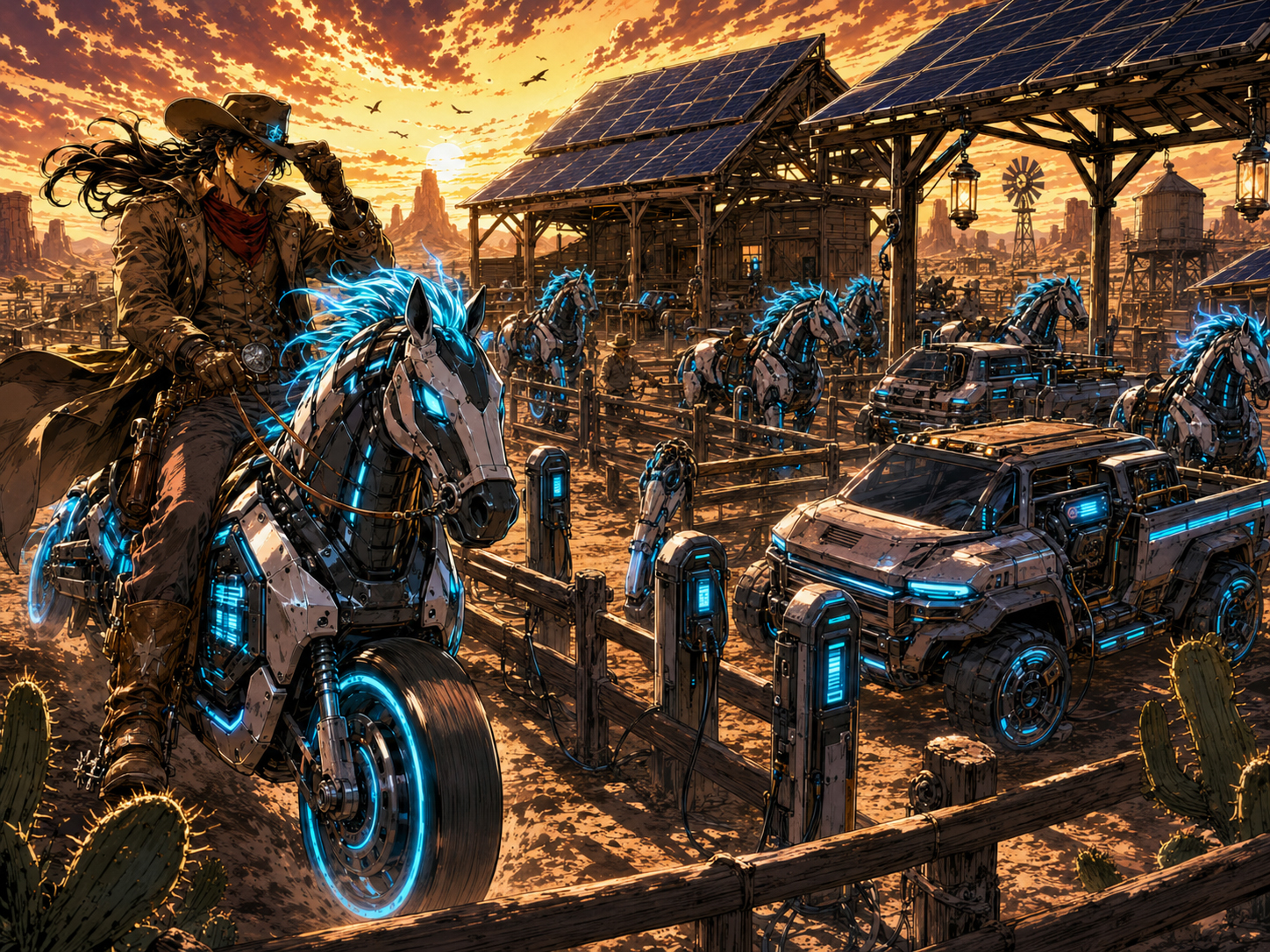
EV Cowboy is educational comedy. The gasoline stagecoach is a joke, but EV chargers, solar systems, batteries, wiring, backup systems, and service upgrades are real electrical systems.
This episode is not electrical advice, vehicle advice, engineering guidance, route guidance, or installation instruction. EV charging equipment, solar arrays, batteries, inverters, service upgrades, breakers, wiring, conduit, and connected systems must be designed, installed, permitted, inspected, and operated according to applicable codes, manufacturer instructions, utility requirements, rate schedules, and local authority rules.
The old fuel machine has failed. The electric steed needs a proper place to charge. The whole town gathers around the new hitching post with wires.